
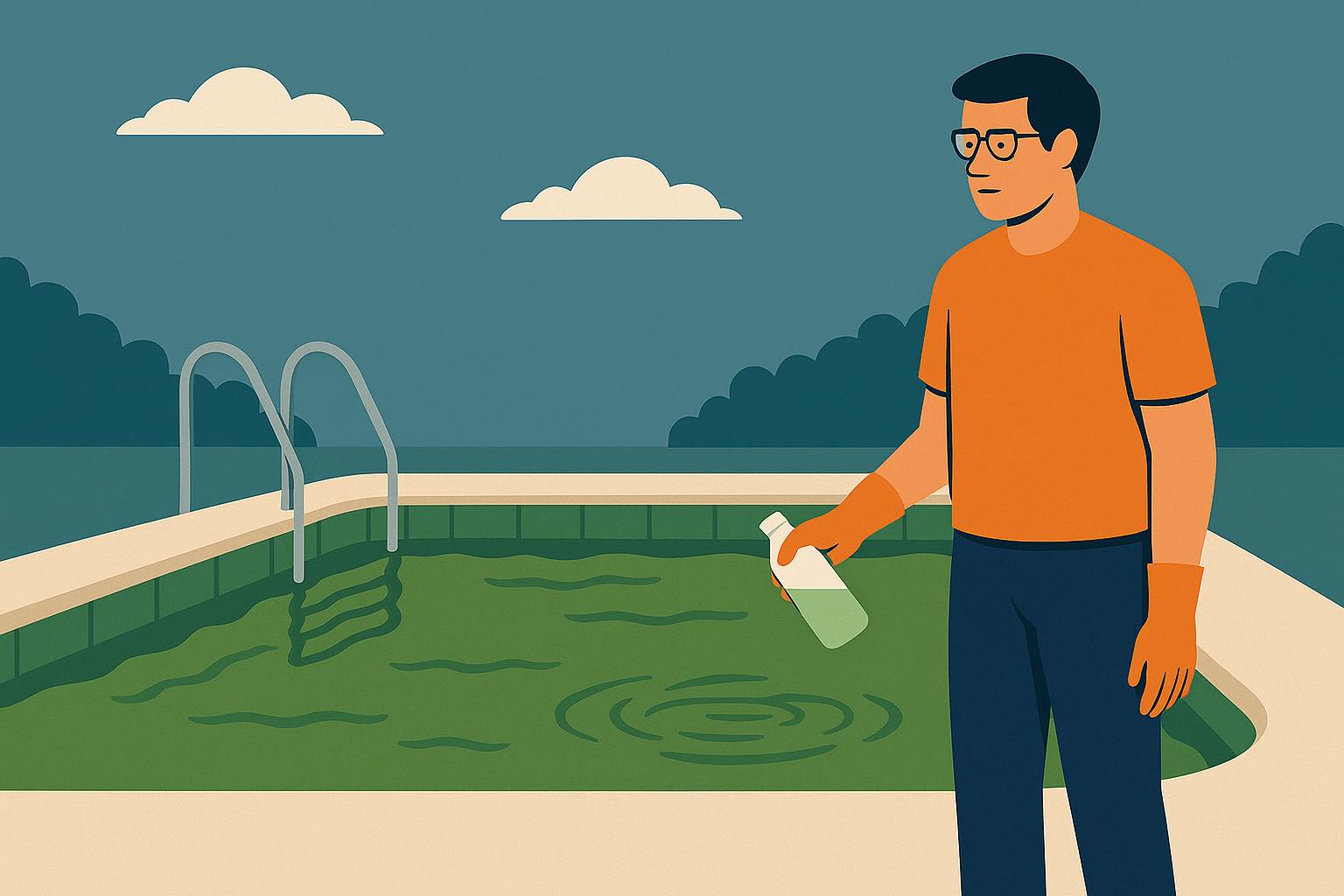
There’s nothing more frustrating than lifting your pool cover to find a murky, green swimming pool. You’re not alone; green pools are a common issue in Australia, especially during the hotter months when algae can bloom overnight.
Most of the time, green pool water is caused by algae. Chlorine is your pool’s first line of defence, keeping algae and other unwelcome guests at bay. But if chlorine levels drop even briefly, algae can quickly take hold, turning your pool into a green lagoon. The good news is that with the right approach, you can get your pool back to its sparkling best.
Why is My Pool Green?
A green pool almost always indicates algae growth. This can occur when chlorine or a salt sanitiser is too low, the pH is out of range, or water circulation is poor.
Warm weather and nutrients such as phosphates allow algae to grow rapidly, so even a single missed chlorine test or heavy rainfall can trigger a green outbreak. You might notice cloudiness, or in some cases a slight green tint even if the water appears clear.
If the water is clear but has a greenish hue, it is often due to high pH, above around 7.6–7.8. High pH reduces chlorine effectiveness and can cause metals in the water to leach a green colour.
In short, most green pools result from algae when sanitiser levels drop or water chemistry is unbalanced. Prompt action can prevent the algae from taking over and help restore your pool to a safe, clear condition.
Fixing a Green Pool – Step by Step
- Test and balance the water:
Start by testing your pool water. Adjust the pH to around 7.2 to 7.6, as high pH makes chlorine far less effective. Also check alkalinity and stabiliser (CYA) if possible, and make sure the chlorine level is very low before shocking the pool to avoid overdosing. - Brush and vacuum to remove green algae in pool:
Thoroughly brush the pool walls, floor and steps with a stiff pool brush. This helps to physically loosen algae clinging to surfaces. Pay attention to corners, steps and shady spots where algae often hide. After brushing, vacuum the pool completely, either to waste or to the filter if possible, to remove as much algae and debris as you can. Brushing and vacuuming first allows your chemicals to work more effectively by removing large clumps of algae. - Shock the pool:
Add a high dose of chlorine shock, also called super-chlorination, to kill the algae. For algae treatment, this usually means raising free chlorine to approximately 10 ppm (about 5–10 times the normal maintenance dose, depending on your pool volume). Distribute it evenly around the pool while the pump is running. The chlorine will eliminate the algae and may temporarily turn the water cloudy. For a detailed step-by-step guide, see our how to shock a swimming pool article. - Add algaecide:
After the initial chlorine shock has circulated for a few hours and chlorine levels have begun to stabilise, treat the water with a quality algaecide. Add the recommended dose around the pool edges. Algaecides help neutralise any remaining algae spores, including more stubborn varieties. If your pool was only lightly green, a clarifier may be sufficient at this stage instead of a strong algaecide. - Run the filter:
Keep the pump and filter running continuously for at least 24 hours. Backwash or clean the filter as needed to remove dead algae and debris. If you have a cartridge filter, remove and rinse the cartridge when the pressure rises. During this period, the water should begin to clear as the dead algae are trapped by the filter. - Use clarifier or flocculant if needed:
If the water is still very cloudy after 24 hours, add a pool clarifier or flocculant. A clarifier causes tiny particles to clump together so the filter can catch them. A stronger flocculant will make dead algae sink to the bottom, where it can be vacuumed up later. Clarifiers are usually added about 24 hours after shocking, while flocculants are used for darker, more severe cases and generally require the pump to be turned off during settling before vacuuming. - Brush, vacuum and backwash again:
Once the clarifier or flocculant has done its job, typically after 24 to 48 hours of filtering, brush and vacuum the settled debris again. Backwash or clean the filter one more time to remove all traces of dead algae. The aim is to fully clear the water. - Re-test and re-balance:
Finally, test your pool chemistry again. Ensure chlorine, pH, alkalinity and stabiliser are at ideal levels. Make any necessary adjustments to prevent algae from returning. Maintaining proper water balance is key to keeping your pool clear and safe.
How to Clear Algae from Your Pool Overnight
If you need to clear your pool quickly, for example before a party, there are ways to speed up the process, although you may need to repeat some steps. Start by adding a high dose of chlorine shock, brush the walls and floor thoroughly, and treat the water with a strong algaecide after the chlorine has stabilised. Keep the pump running continuously and consider adding a clarifier immediately after 24 hours. Some pool owners also use a flocculant after 24 hours and vacuum up the settled sludge straight away.
It is important to remember that completely clearing a heavily green pool in 12 to 24 hours is difficult. It often takes a couple of days of continuous filtering. However, combining shock treatment, algaecide, and clarifier can make very rapid progress.
Best Tools and Equipment for Cleaning a Green Pool
Having the right tools makes the job much easier. A stiff pool brush with a long-handled pole is essential. Use a nylon or stainless-steel brush on walls and tiles to scrub off algae patches. After brushing, vacuum the pool thoroughly. You can vacuum manually or with a pump-powered vacuum head, but move slowly to allow the filter to catch algae particles. Don’t forget to empty the skimmer and pump baskets of debris.
For larger pools or to save effort, consider an automatic robot pool cleaner. Modern robotic pool cleaners can scrub floors and walls on their own while vacuuming as they move. These machines are designed to climb walls and remove algae, helping to keep the water clear with minimal manual work.
After cleaning, make sure to clean your filter system thoroughly. Backwash sand or DE filters until the water runs clear. Cartridge filters should be hosed off and soaked if very dirty. Properly cleaning the filter ensures no dead algae remain to cause problems later.
How to Prevent a Green Pool
The best way to deal with a green pool is to prevent it in the first place. Keep your pool chemistry balanced and run the pump daily. Maintain a free chlorine level of around 2 to 4 parts per million, which is widely recommended to prevent algae growth. Test your water at least once a week, or more often if possible, and skim leaves and debris off the surface daily, as decaying matter feeds algae. Clean or backwash the filter regularly to ensure good circulation.
Shocking your pool once a week, or after heavy rain or periods of heavy use, can also help keep algae at bay. Use a pool testing kit to check pH, alkalinity, and chlorine levels. Remember that if the pH rises above around 7.6–7.8, chlorine will be much less effective. Keeping alkalinity in the correct range, around 80 to 120 parts per million, also helps stabilise the pH.
In short, maintain proper chemical balance, shock regularly, and keep the water moving. If you follow these steps consistently, your pool will stay clear, and you will rarely have to deal with green water again.


